

Stormont debates “hazardous” conversion therapy Bill
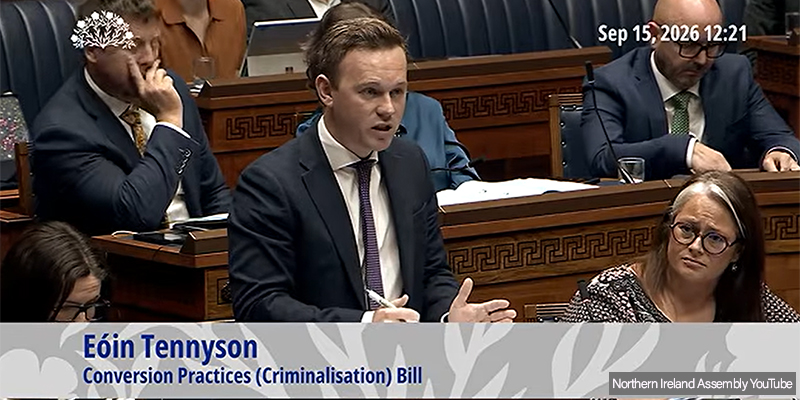
On Tuesday, MLAs debated Eóin Tennyson’s Conversion Practices (Criminalisation) Bill.
The debate ran late but, with many more MLAs still to speak, there will be at least another day of debate before the Bill is put to a vote. Day two is scheduled for Tuesday 22 September.
Under the Bill, parents and church leaders could face up to two years in prison if they are deemed to be intending “to change or suppress sexual orientation or gender identity”. This could include a parent who stops their child from taking cross-sex hormones.
There were strong speeches against the Bill from the Unionist benches. DUP, UUP and TUV MLAs took to their feet to dismantle Mr Tennyson’s claims and raise concerns about the Bill’s draconian reach into families and churches.
In his opening speech, Mr Tennyson claimed that: “People are locked in cupboards until they reflect and repent, or are threatened with rape if they do not change their identity. Those are real stories that involve real people in our communities and real abusers who are getting away with that heinous abuse. With this Bill, that changes.”
It is wrong for Mr Tennyson to claim that gay and trans people are currently unprotected from such abuse when it is so clearly already illegal. As Phillip Brett (DUP) argued, locking someone in a cupboard and threatening to rape someone are unquestionably criminal offences.
UUP leader Jon Burrows argued that the Bill has some of the “lowest thresholds” he’s “ever seen”, such that “a parent would, in effect, need a KC at the kitchen table before having conversations with their child”. He later added: “This Bill makes good parenting hazardous and freedom of expression dangerous, and I therefore urge everybody to vote against it at Second Stage.”
The TUV’s Timothy Gaston described the Bill as an attack on the home and the Church.
Diane Dodds (DUP) took apart Mr Tennyson’s claims that his Bill does not criminalise ordinary parenting and church work. She argued that “not only is freedom of speech about being able to persuade and lead people to a particular viewpoint but… for the Churches, in particular… It is directive: it urges us to live and be a particular way.” Such speech, she said, would be criminalised under the Bill.
Several MLAs quoted from Aidan O’Neill KC’s scathing legal opinion on the Bill, commissioned by The Christian Institute, in which he argued that the proposals are fundamentally illiberal, poorly drafted, and pose a severe threat to basic civil liberties.
Peter Martin (DUP) highlighted another group that would be impacted: teachers. He argued that, under the Bill, teachers could be accused of ‘conversion practices’ if they “took a cautious, exploratory approach with gender-distressed or gender-questioning pupils rather than affirming immediate social transition”.
Finally, a jaw-dropping moment came when Sinn Féin Principal Deputy Speaker Carál Ní Chuilín ruled it out of order for Jonathan Buckley (DUP) to press Mr Tennyson on just how many ‘gender identities’ would be covered by his Bill, saying: “It is not for Eóin Tennyson or anyone else to talk about how many genders there are.” This was a perfectly reasonable question for Mr Buckley to ask, given that the Bill would introduce gender identity into law for the first time without so much as defining it.
There was some good media coverage in the run-up to the debate, with growing attention on what the Bill could mean for parents. The Belfast Telegraph gave the issue front-page prominence, highlighting Mr O’Neill’s legal advice arguing that the Bill’s vague and ill-defined wording could criminalise parents who restrict their non-LGBT children from watching hardcore pornography. Let Us Pray’s James Kennedy was also quoted by the BBC and UTV.
Stormont debates “hazardous” conversion therapy Bill
2026-09-18 14:22:08Scotland’s still passing the buck on ‘conversion therapy’
2026-09-08 11:49:33Will Westminster’s draft conversion therapy Bill apply to Scotland?
2026-08-03 15:32:47