

Prayer is the “most insidious” conversion practice, Ozanne tells Committee
Day two of oral evidence on the draft Conversion Practices Bill focused on ‘lived experience’.
The Committee heard from Jayne Ozanne and Ian Smith, who both say they experienced ‘conversion practices’ in a Christian setting, in an attempt to change their sexuality.
If you’ve been following our campaign for any length of time, Jayne Ozanne will need no introduction. Founder and former chair of the Ban Conversion Practices Coalition, she has spent years campaigning for a ban that targets traditional Christian teaching on sexual ethics – all while continuing to claim to speak on behalf of Christians.
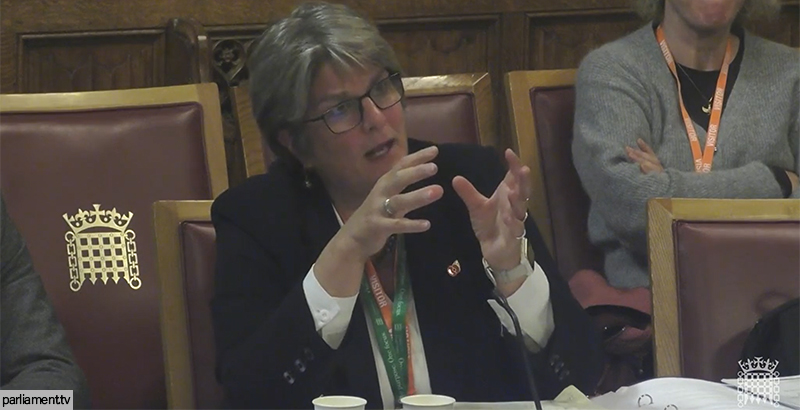
Ozanne made no secret of these ambitions in her evidence to the Committee. She repeatedly branded prayer ‘abusive’ and argued that the draft Bill does not go far enough to criminalise it. You can watch our compilation video here.
She claimed that “everyday prayer counselling” accounts for the ‘vast majority of conversion practices’, telling the Committee: “We don’t have sufficient law in place at the moment to cover this most insidious form – which is prayer.” She also said she hoped a ban would “put the fear” into friends and family praying for their loved ones – where those prayers don’t affirm a person’s LGBTQ+ identity.
This is very on brand for Ozanne. She has infamously called for even “gentle, non-coercive prayer” to be outlawed under a ban and has endorsed Victoria, Australia’s conversion practices law as “the gold standard”. Guidance issued to people of faith in Victoria on complying with the law warns against praying “for a person not to act on their attractions”, talking “about a person’s brokenness or need to repent”, and asking “for long-term celibacy”.
Ozanne also complained that the draft Bill fails to address “suppression” – which she describes as “by far the most normal form” of conversion practices in religious settings. Yet her definition includes encouraging celibacy – which is, of course, a mainstream Christian teaching. By that logic, even a dad telling his son not to sleep around could find himself accused of carrying out a ‘conversion practice’.
Another jarring moment was when Ozanne was pressed on how, exactly, she envisaged prayer being prosecuted. She compared the difficulty of prosecuting private prayer with that of prosecuting rape: “Evidence of one prayer which nobody else witnesses, I don’t think you’d be able to prosecute. Still wrong. We have that… in the problem of rape sadly. A lot of women get raped, they can’t prove it and the CPS won’t prosecute. This is sadly very similar.”
She also took aim at the thousands of evangelical churches that teach the need for “transformation”, branding it “code for you must change yourself, you must deny yourself”. Recalling a radio interview with a vicar, Ozanne protested that he had told her she needed to deny herself because “Christ had died for her”. She regarded this, too, as an example of a ‘conversion practice’. Yet this is precisely what the Christian faith is about: transformation, the need for every human being to turn from sin and towards Christ. Without the need for transformation, there is no Gospel.
However, it is important to remember that Ozanne is far from the only one pushing this. There is no version of this Bill that its advocates would accept that would not trample on the ordinary work of churches. If the Government is so confident that its draft Bill safeguards religious freedom, why is that protection nowhere to be found in its wording?
Labour voters overwhelmingly oppose Govt’s conversion practices ban
2026-11-09 16:29:53Prayer is the “most insidious” conversion practice, Ozanne tells Committee
2026-11-09 16:27:53